AVIATION CATERING MASTERY: THE ALUMINUM FOIL PACKAGING IMPERATIVE
(Introduction) The Altitude Audit: Where Precision Meets Palate
In the aviation industry, margins are measured in fractions of a cent and safety is measured in absolute zeros. The ecosystem of inflight catering is unlike any other sector of the food and beverage industry. It operates under a unique set of constraints: extreme space limitations, strict weight restrictions, and a "Cook-Chill-Reheat" thermal cycle that demands exceptional material performance. In this high-pressure environment, the humble aluminum foil container—often referred to as the "casserole" in aviation parlance—is not merely a disposable vessel. It is a mission-critical component of the service delivery chain.
This document bypasses the rudimentary basics. Written from the perspective of a supply chain specialist with two decades of experience in large-scale industrial catering, we will dissect the operational engineering behind airline aluminum packaging. We will move beyond the catalog specifications to analyze fuel-burn economics, thermal thermodynamics, and the crucial role of supplier consistency. For the procurement director or catering operations manager, this is a blueprint for optimizing the critical path between the flight kitchen and the passenger’s tray table.
1. Payload Economics: The Financial Gravity of Weight & Volume
In aviation, weight is cost. Every gram added to an aircraft requires fuel to lift it. Therefore, the selection of airline aluminum foil containers is primarily an exercise in payload optimization. We must analyze the packaging not just by its unit price, but by its "flying cost."
The Material Thickness vs. Integrity Calculation
Central Node: Material Selection
Branch A: The "Lightweight" Trap
Risk: Reduce gauge to <60 microns.
Consequence: Container walls buckle during high-speed plating or crushing in the compactor, leading to galley messes and flight attendant complaints.
Branch B: The Optimized Standard
Target: High-grade alloy with engineered structural ribs.
Benefit: Maintains structural rigidity while shaving 15% off the weight compared to generic alternatives.
Outcome: Reduced fuel burn over thousands of flight cycles per year.
Procurement officers must understand the metallurgy. The goal is to source lightweight food containers that utilize advanced alloy tempers. This allows for thinner walls without compromising the stacking strength required to withstand the G-forces during takeoff and landing. A difference of 0.5 grams per container, multiplied by 300 passengers, over 5,000 flights annually, results in a tangible reduction in jet fuel consumption. This is the definition of operational efficiency.
Cubic Efficiency and Galley Loading
Space inside an aircraft galley is the most expensive real estate in the world. Inflight meal solutions must maximize density.
Standard Retail Designs: Often feature flared rims or wide-angled walls. While stackable, they trap excessive air ("dead volume") between units.
Aviation-Specific Design: Features nearly vertical walls and tight nesting tolerances. This allows catering trucks to load 20-30% more meals per trolley (standard Atlas or KSSU capability).
By switching to a supplier that engineers containers specifically for high-density nesting, airlines can reduce the number of carts required per flight, freeing up space for duty-free merchandise or extra seating, thereby directly impacting ancillary revenue.
(IMAGE 1 DESCRIPTION)
Image Content: A technical cross-section diagram showing two stacks of aluminum containers. The stack on the left (Retail) is taller with fewer units. The stack on the right (Aviation Spec) is shorter but contains more units, highlighting "High-Density Nesting."
Caption: Optimizing galley density: High-precision nesting reduces air gaps and maximizes cart utilization.
ALT Text: Comparison of standard versus high-density nesting for airline aluminum foil containers.
2. Thermal Dynamics: Mastering the Cook-Chill-Reheat Cycle
The defining challenge of aviation catering is the temperature journey. Meals are prepared, blast-chilled, transported, stored, and finally re-thermalized in dry-heat convection ovens at altitude. The airline aluminum foil container must act as a perfect thermal conductor and a protective barrier simultaneously.
Thermodynamics and the Smooth-Wall Advantage
Component: The Smooth-Wall Casserole
The Engineering: unlike "wrinkle-wall" containers, smooth-wall variations offer a flat rim surface.
Thermal Conductivity: Aluminum offers superior heat transfer rates compared to CPET plastics. This reduces the time required in the onboard oven to reach core serving temperatures.
Result: Shorter reheating cycles mean less power consumption from the aircraft's APU/engines and faster service delivery to passengers.
The industry is increasingly shifting towards smooth-wall heat-sealable aluminum trays. These containers allow for a hermetic seal with lidding film, which prevents desiccation (drying out) of the food during the blast-chilling and reheating phase. This is critical for maintaining food quality at 35,000 feet, where low cabin humidity already dulls the palate.
Mitigating Thermal Shock and Deformation
A common failure point in inferior packaging is warping. When a container moves rapidly from a cold environment (<5°C) to a hot oven (>150°C), thermal shock can cause lower-grade alloys to warp.
The Incident: An airline experienced leakage of sauce-heavy meals during the reheating phase.
Root Cause: The incumbent supplier used a "soft" temper aluminum that deformed slightly under heat, breaking the seal with the foil lid.
The Solution: Transitioning to a container with a reinforced rim curl and a harder alloy temper.
Operational ROI: Elimination of "burned-on" food spills in the oven (reducing cleaning time) and prevention of sauce leakage onto passenger clothing. Reliability in thermal performance is non-negotiable.
3. The Safety Protocols: Hygiene and Contamination Control
In a closed environment like an aircraft, a foodborne illness outbreak is a catastrophic event. Aviation food safety standards surpass even strict restaurant codes. The packaging is the first line of defense.
HACCP Integration and Contaminant Prevention
Manufacturing: The production of the aluminum foil itself involves high-temperature annealing, effectively sterilizing the material.
Lubrication: Aviation-grade containers must use food-contact approved, FDA-compliant lubricants during the stamping process. Lower-tier suppliers often use industrial oils that leave a residue/odor upon heating.
The "Shallow" Draw: Casseroles must be designed without deep crevices or tight corners where food bacteria can hide during the washing/recycling phase (if reusable rotable lids are used) or where manufacturing dust can accumulate.
Purchasing managers must audit their suppliers' lubrication reports. The presence of non-food-grade lubricant residue can vaporize in the aircraft oven, causing off-odors that circulate through the cabin ventilation system. This "smell of failure" immediately degrades the passenger experience.
Hermetic Sealing and Tamper Evidence
Component A (Container): Smooth-rim aluminum tray.
Component B (Lidding): High-performance polymer-coated aluminum foil.
Integration: Heat sealed.
This combination provides two critical functions:
Bio-security: It creates a complete barrier against airborne pathogens during transport from the catering unit to the high-lift truck to the aircraft.
Tamper Evidence: An intact seal assures the passenger that their meal has not been touched since leaving the sanitized kitchen.
Moving away from loose-fitting plastic lids to heat-sealed foil dramatically improves hygiene metrics and reduces total packaging weight.
(IMAGE 3 DESCRIPTION)
Image Content: A macro close-up of a "peel-tab" corner of an airline meal. It shows the strong bond of the film to the smooth aluminum rim, ensuring a perfect seal.
Caption: Hermetic sealing provides the ultimate bio-security barrier for inflight catering.
ALT Text: Close-up of heat-sealed lid on an airline aluminum casserole ensuring hygiene.
4. Brand Perception: Aesthetics at 35,000 Feet
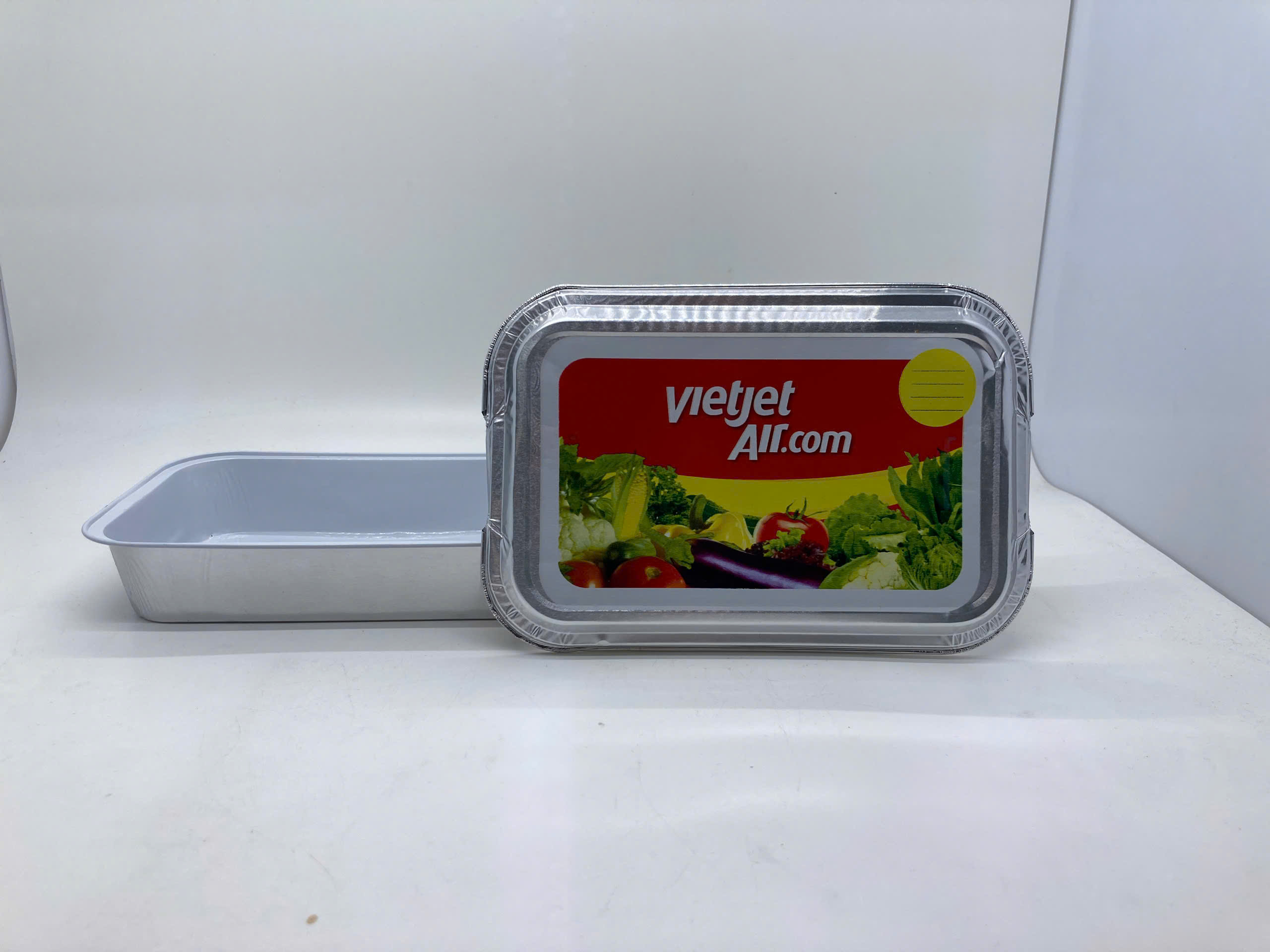
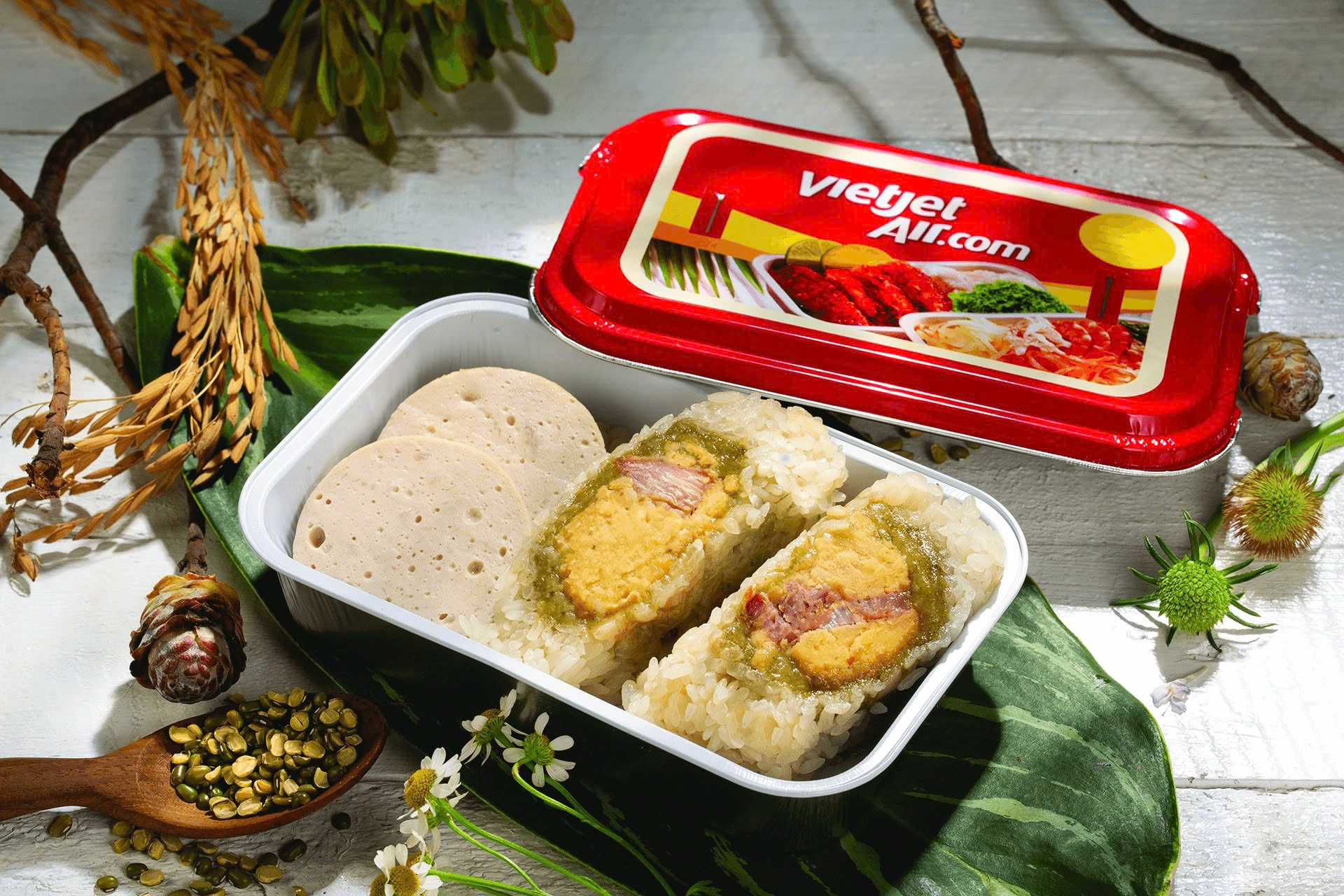
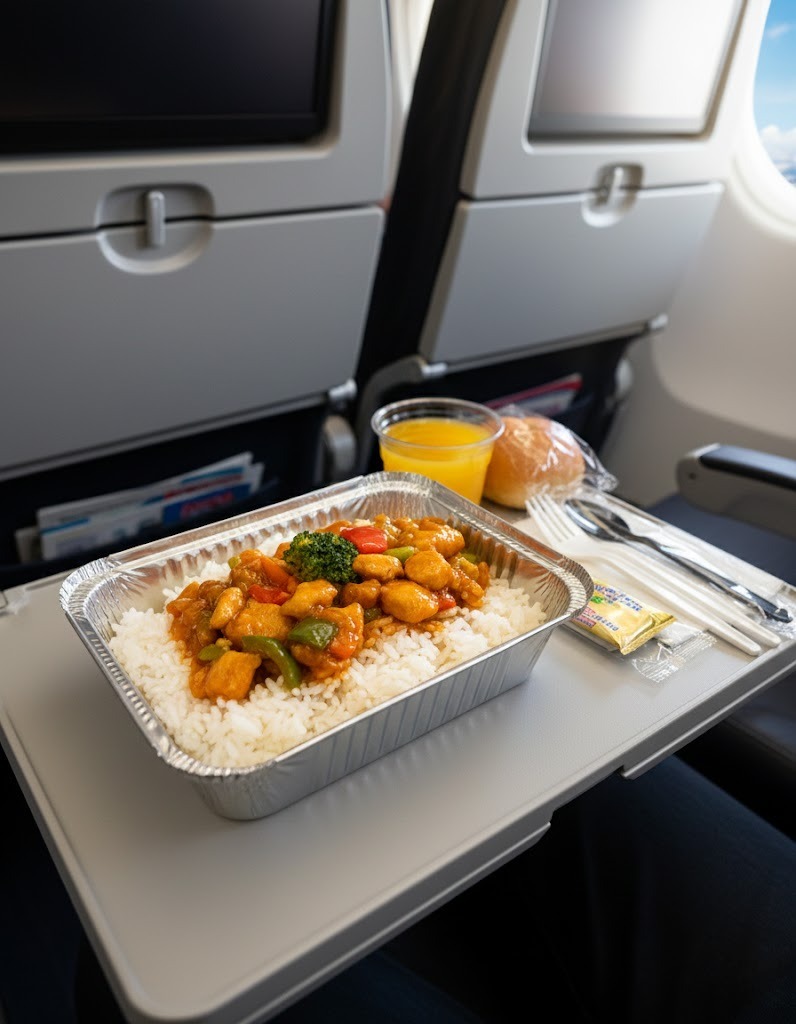
We eat with our eyes first. In Economy and Premium Economy classes, the casserole is the plate. Aircraft catering supplies are a tangible touchpoint of the airline's brand.
Visual consistency and Color Psychology
Past: Plain, silver, wrinkled foil containers looked industrial and utilitarian, subconsciously lowering the perceived value of the meal.
Present: Leading airlines utilize "lacquered" aluminum.
The Upgrade: Using Gold, Black, or specific brand-colored lacquer on the exterior of the aluminum container.
Psychological Impact: A black lacquered exterior mimics ceramic cookware. It elevates a standard "chicken and rice" dish to a "premium dining experience." It frames the food, creating contrast that makes ingredients pop visually.
This is a low-cost capital investment for a high-value return in passenger satisfaction surveys (CSAT).
Ergonomics of the Tray Setup
Argument (The Accountant): "Let's use the deepest possible container to prevent spills."
Rebuttal (The UX Designer): "No. The passenger is eating in a confined space with limited elbow room. A container that is too deep forces an awkward eating angle. We need a 'shallow profile' container with a wider surface area."
The Ergonomic Solution: Using smooth-wall aluminum casseroles that are compatible with the "Atlas" standard meal tray dimensions (usually 1/1, 2/3, or 1/2 size). The dimensions must ensure the container sits flat and stable on the anti-skid mat, preventing sliding during turbulence.
5. Strategic Sourcing: The Loc Tu Advantage
The complexity of the aviation supply chain means that "Just-in-Time" (JIT) is not just a buzzword; it is a necessity. A flight cannot be delayed because the disposable airline food packaging didn't arrive at the kitchen.
Supply Chain Resilience and Certifications
Criteria 1: Capacity Buffer. Does the supplier have the throughput to handle holiday peak seasons or sudden flight schedule increases?
Criteria 2: Regulatory Documentation. Aviation audits are rigorous. The supplier must provide instant access to ISO certifications, FDA compliance sheets for alloys/coatings, and heavy metal migration tests.
Criteria 3: Logistics Integrity. Can the supplier palletize according to specific airline warehousing requirements (e.g., specific stack heights to fit racking systems)?
Sourcing is about risk mitigation. A partnership with a manufacturer like Loc Tu ensures that the supply line remains unbroken, regardless of global logistics disruptions.
The Loc Tu Collaborative Model
At Loc Tu, we do not simply sell containers; we integrate into your catering cycle.
Phase 1 - Tooling Consultation: We assess your current ovens and tray setups to recommend existing molds or engineer custom tooling for unique dimensions.
Phase 2 - Material Calibration: We adjust the alloy thickness based on your specific menu requirements (heavy items like stews vs. light items like pasta).
Phase 3 - Sample Testing: We provide production-grade samples for your test kitchen to run full "Cook-Chill-Reheat" validations.
Phase 4 - Strategic Stocking: We establish a rolling inventory forecast to ensure zero-stockout incidents.
This collaborative approach shifts the relationship from transactional buying to strategic operational support.
(IMAGE 5 DESCRIPTION)
Image Content: A logistics visualization map or a warehouse photo showing perfectly palletized boxes with "Aviation Grade" labels, ready for shipment.
Caption: Precision logistics and robust inventory management are the backbone of a reliable catering operation.
ALT Text: Warehouse inventory of Loc Tu airline aluminum foil containers ready for global shipping.
(Conclusion) ASCENDING TO OPERATIONAL EXCELLENCE
In the analysis of aviation catering, the aluminum foil container proves to be a fulcrum of efficiency. It balances the opposing forces of cost reduction (weight saving) and service elevation (food quality and presentation). By viewing airline aluminum foil containers not as a commodity, but as a technological instrument, catering directors can unlock significant value.
The transition to high-precision, smooth-wall, and chemically safe packaging solutions is an investment in the airline's reputation and bottom line. Partnering with a dedicated specialist like Loc Tu ensures that every meal served at 35,000 feet meets the highest standards of safety, consistency, and culinary excellence.
The runway to better catering operations begins with the right packaging strategy. 🛫🍽️
Loc Tu: Pioneering Excellence in Premium Aluminum Packaging Solutions
At the forefront of the food packaging industry, Loc Tu Manufacturing & Trading Co., Ltd. stands as a premier manufacturer and supplier of high-quality aluminum trays and foil rolls. We are dedicated to providing innovative, safe, and reliable packaging solutions tailored to the dynamic needs of the modern food landscape. Our foundation is b0uilt upon state-of-the-art manufacturing facilities, equipped with advanced production lines engineered for precision and efficiency. This technological edge allows Loc Tu to consistently deliver aluminum trays and foil rolls that not only meet but exceed rigorous international food safety standards.
Why You Must Choose Loc Tu?
✅ Assured Quality & Safety: Crafted from premium, food-grade aluminum, free from harmful impurities, meeting international safety benchmarks.
🔥 Optimal Thermal Properties: Ensures even cooking and excellent heat retention, preserving food temperature and taste effectively.
💪 Durable & Convenient Design: Engineered to resist leaks and dents, providing reliable performance for baking, storage, and transport.
🔄 Versatile Solutions: Our extensive range caters to various applications – from baking and steaming to storing fresh food and takeaway meals.
🌱 Eco-Conscious Packaging: Made from 100% recyclable aluminum, supporting sustainability and reducing plastic waste.
🎯 Brand Enhancement: Optional custom printing available to personalize products and boost your brand visibility.
🚚 Reliable Supply & Delivery: Capable of handling large orders with dependable, on-schedule nationwide shipping.

Loc Tu – Trusted Manufacturer of Durable Aluminum Foil Containers and High-Quality, Food-Safe Aluminum Foil Rolls for Your Kitchen
Your Trusted Partner in Food Packaging 📞
Loc Tu Manufacturing & Trading Co., Ltd. is more than just a supplier; we are your strategic partner in delivering high-caliber aluminum food packaging solutions. Specializing in a comprehensive range of aluminum trays, versatile foil rolls, and convenient disposable food containers.
We serve a diverse clientele – from individual households and local food vendors to large-scale restaurants, catering companies, and prestigious hotel chains. Our unwavering dedication to safety, sustainability, innovation, and customer satisfaction makes us the trusted choice for businesses and consumers seeking reliable, high-performance packaging.
📌 LOC TU MANUFACTURING & TRADING CO., LTD
📌 Our Vietnamese Website: Khaynhomthucpham.com
📌 HOTLINE/ZALO: 0969.787.309
📌 Facebook: Aluminum Foil Loc Tu
📌 Youtube: Aluminum Foil Loc Tu
📌 Tik Tok: Aluminum Foil Loc Tu
📌 Instagram: Aluminum Foil Loc Tu
📌 Shopee: Aluminum Foil Loc Tu
📌 Twitter/X: Aluminum Foil Loc Tu
📌 LinkedIn: Aluminum Foil Loc Tu
📌 Pinterest: Aluminum Foil Loc Tu
📌 Tumblr: Aluminum Foil Loc Tu
📌 Threads: Aluminum Foil Loc Tu
📌 Telegram: Aluminum Foil Loc Tu
📌 Whatsapp: 0969.787.309
📌 Branch 1 (Hanoi): No. 1 Pham Tu, Beasky Building, Dai Kim Ward, Hoang Mai District, Hanoi
📌 Branch 2 (Binh Duong): No. 68, DX 051 Street, Group 17, Quarter 4, Phu My Ward, Thu Dau Mot City, Binh Duong Province
📞 Contact us today for expert consultation and the best pricing on premium aluminum trays and foil packaging solutions! 🚀

