FOIL-WRAPPED ROASTED CHICKEN: THE INTERSECTION OF CULINARY PHYSICS AND BUSINESS PROFITABILITY
(Introduction Title) Elevating a Classic Technique to a Commercial Asset
In the relentless ecosystem of the modern Food and Beverage industry, a menu item must justify its existence through two metrics: palate impact and profit margin. The preparation of poultry, specifically the technique of roasting chicken within a sealed aluminum environment (Gà nướng giấy bạc), represents a unique convergence of these metrics. It is more than a recipe; it is an asset management decision.
For the Executive Chef, the foil vessel acts as a miniature pressure cooker, utilizing steam and convection to break down collagen while infusing marrow-deep flavor. For the Operations Director, it represents a standardized unit of production that minimizes shrinkage (weight loss), reduces cleaning labor, and facilitates rapid service.
This analysis dissects the "Foil-Roasted Chicken" not merely as a dish, but as a systematic approach to high-efficiency volume feeding. By leveraging high-grade materials and precise thermal management, an establishment can transform a commodity ingredient into a signature experience that commands premium pricing while keeping food costs aggressively low.
TABLE OF CONTENTS
Thermodynamics of Enclosure: The Science Behind Foil Roasting
Workflow Synchronization: Streamlining Back-of-House Operations
Yield Economics: Maximizing Profitability Through Moisture Retention
Sensory Delivery: The Theatrics of Tableside Unwrapping
Material Procurement: Defining Standards for Heavy-Duty Foil
1. Thermodynamics of Enclosure: The Science Behind Foil Roasting
To master the product, one must understand the physics governing the cooking process. Aluminum foil is not just a wrapper; it is a highly conductive thermal barrier that fundamentally alters the heat transfer equation.
The dynamics of steam circulation and collagen breakdown
Icon: 🧪
Concept: The Maillard-Steam Paradox.
Typically, chefs must choose between the Maillard reaction (browning/crisping) which requires dry heat, and hydrolysis (softening meat) which requires wet heat.
The foil-wrapped technique allows for a dual-phase thermal event:
The Sealed Phase: As the internal temperature rises, moisture from the chicken and aromatics converts to steam. Trapped by the wholesale aluminum foil casing, this high-pressure environment rapidly breaks down connective tissue (collagen into gelatin) without drying the protein fibers. This is critical for bone-in cuts which often dry out before they are fully cooked.
The Conductive Phase: Aluminum's high thermal conductivity ensures that heat is distributed evenly across the surface of the meat, eliminating cold spots and ensuring consistent food safety without overcooking the exterior.
Infusion efficiency and flavor density analysis
In open roasting, volatile aromatic compounds—herbs, garlic, five-spice, marinades—evaporate into the oven vent. This is effectively "flavor loss."
In an enclosed foil system, these volatile compounds are trapped against the protein surface. This creates a forced-infusion effect.
The Result: The marinade penetration depth increases by up to 40% compared to open roasting.
The Implication: Kitchens can use less expensive marinade ingredients to achieve the same flavor profile, or standard amounts to achieve a far superior taste. This is "ingredient optimization" at a chemical level.
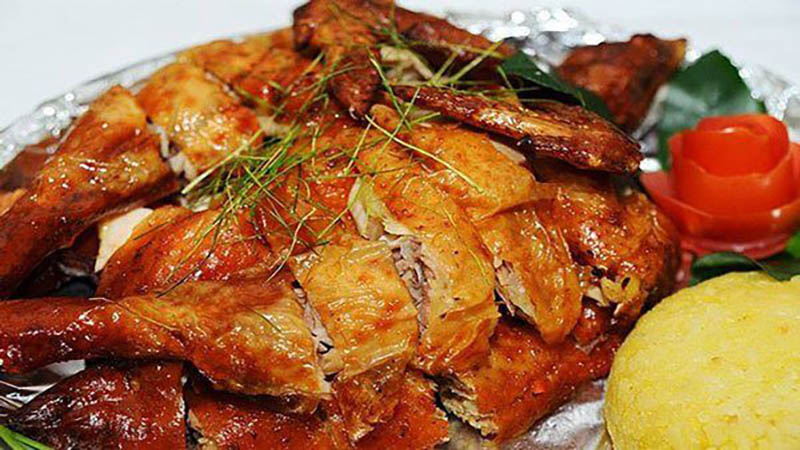
[IMAGE 1 DESCRIPTION]
Image Content: A close-up, high-contrast shot inside a professional kitchen. A "cut-away" view (cross-section) of a foil packet inside an oven. Inside the packet, you see the chicken leg surrounded by swirling steam (visualized artistically) and bubbling marinade.
Caption: The enclosed thermal environment creates a pressurized steam cycle, maximizing flavor infusion and moisture retention.
ALT Text: Cross-section view of foil-roasted chicken showing steam circulation inside wholesale aluminum foil.
2. Workflow Synchronization: Streamlining Back-of-House Operations
A dish that tastes good but bottlenecks the kitchen line is a liability. Foil-roasted chicken is chemically engineered for speed and consistency, stabilizing the chaotic "rush hour" service.
Batch preparation and "Mise-en-place" logistics
Historically, chicken orders were fired à la minute, requiring 25-45 minutes of oven space per order, often causing traffic jams at the pass.
The "Foil-Integrated Workflow" revolutionizes this:
Morning Prep: Chicken is marinated, portioned, and wrapped in heavy-duty wholesale aluminum foil hours before service.
Stacking efficiency: Because the raw ingredients are sealed, cross-contamination risks are minimized. These packets can be stacked efficiently in walk-in coolers, occupying 30% less space than open hotel pans.
The Firing Line: When an order comes in, the chef simply moves a pre-wrapped unit from the lowboy fridge to the oven. Zero prep time during service. This allows a single line cook to manage high volumes without compromising quality.
Minimizing turnover time and cleaning labor
Strength - Reduced Scrubbing: The foil acts as a sacrificial vessel. The stubborn, burnt-on marinade that usually requires aggressive chemical scrubbing of baking sheets is contained entirely within the disposable foil.
Strength - Rapid Turnaround: Kitchen porters spend less time washing pots and pans.
Opportunity - Oven Life: Reducing carbon buildup in commercial ovens reduces the frequency of deep cleans and maintenance service calls.
Threat (Mitigated): By using wholesale aluminum foil, the cost of the wrapper is fractions of a cent compared to the labor cost of scrubbing a hotel pan for 10 minutes.
3. Yield Economics: Maximizing Profitability Through Moisture Retention
In B2B foodservice, you buy by weight (raw), but you sell by the plate. Any weight lost during cooking is effectively money evaporating into the air.
Analytical comparison of "Shrinkage Rates"
Let us examine the numbers on a standard 1.5kg Whole Chicken.
Scenario A: Conventional Open Roasting
Temperature: 200°C.
Evaporation & Rendering: High.
Shrinkage: Approximately 25-30%.
Yield: ~1.1kg of sellable meat.
Scenario B: Enclosed Foil Roasting
Temperature: 220°C (Higher heat allowed due to protection).
Evaporation: Negligible (Moisture is recaptured).
Shrinkage: Approximately 5-8%.
Yield: ~1.38kg of sellable meat.
The Financial Verdict: You retain nearly 20% more product volume per bird. Across a monthly volume of 500 chickens, this equates to virtually receiving 100 free chickens simply by changing the cooking vessel to wholesale aluminum foil.
Cost-Benefit scaling for bulk operations
Central Node: Profit Maximization
Branch 1: Reduced Energy Costs. The high thermal conductivity of aluminum speeds up the internal heating process, reducing oven time by 10-15%.
Branch 2: Portion Perception. A juicier, plump bird (due to high yield) looks larger on the plate. This allows for higher menu pricing or "Value Perception" marketing without increasing raw food cost.
Branch 3: Foil Cost vs. Detergent Cost. The cost of the foil unit is historically lower than the combined cost of hot water, chemicals, and labor required to clean heavy stainless steel roasting pans.
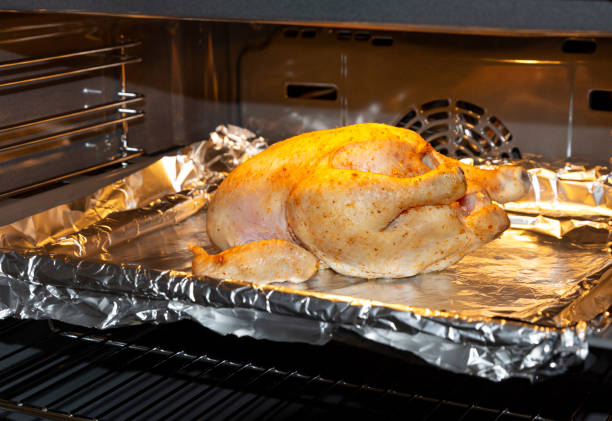
[IMAGE 3 DESCRIPTION]
Image Content: A split-screen infographic style image. Left side shows a dry, slightly shrunken roast chicken on a pan with "25% Weight Loss" in red text. Right side shows a plump, glistening chicken sitting on opened foil with "8% Weight Loss" in green text.
Caption: Yield retention analysis proves that enclosed roasting preserves sellable product weight significantly better than open methods.
ALT Text: Comparison of chicken shrinkage rates between open roasting and foil-roasted methods.
4. Sensory Delivery: The Theatrics of Tableside Unwrapping
Dining is an immersive experience. The functionality of foil extends beyond the oven—it becomes a critical component of the guest's sensory journey.
Aromatics and the "Olfactory Reveal"
Component 1: The Vessel. The foil packet is served directly onto the plate or a wooden board. It arrives sizzling.
Component 2: The Anticipation. The customer must interact with the food. As they cut or tear open the silver seal...
Component 3: The Release. A concentrated cloud of aromatic steam (lemongrass, rosemary, charcoal smoke) escapes instantly, hitting the diner's face.
This "Olfactory Reveal" creates a neurological link to freshness. It confirms to the diner that "this was cooked just for me." This theatricality cannot be replicated by plating pre-sliced chicken from a holding cabinet.
Thermal integrity during service and delivery
The Case: "Rooster Express," a specialized rotisserie delivery brand.
The Issue: By the time riders reached customers (20 mins away), roasted chicken in cardboard boxes was lukewarm and dry.
The Solution: Transitioning to foil-wrapped packaging.
The Outcome: The aluminum foil acts as a thermal insulator (reflecting radiant heat back into the meat). Customers reported receiving food that was still "piping hot." This dramatically reduced refunds and improved App Ratings. Foil is the champion of the "Last Mile" temperature problem.
5. Material Procurement: Defining Standards for Heavy-Duty Foil
Not all foils are created equal. In a commercial environment dealing with bones, high heat, and acidic marinades, sourcing the correct specification is non-negotiable.
Critical technical specifications for commercial application
Icon: 📏
Spec Sheet - Sourcing for Poultry:
Gauge (Thickness): Do not settle for standard retail "Economy" foil (11-13 microns). For roasted chicken, which has sharp protruding leg bones, you require Heavy Duty (18-20 microns) or Extra Heavy Duty. Thin foil will puncture, leaking valuable juices and ruining the steaming effect.
Alloy Purity: Ensure the manufacturer provides certification (ISO/FDA/HACCP) for 8011 or 3003 alloy. It must be certified Food Grade to prevent any metallic leaching when in contact with acidic ingredients (lemon, tomato-based marinades) at high temperatures.
Width: Commercial 45cm rolls are essential for wrapping whole birds or large quarters in a single sheet without clumsy double-folding.
Establishing a reliable supply chain partnership
Buyer: "I can get cheap foil rolls from the general market. Why bother with a specialized B2B supplier?"
Expert: "Consistency is the enemy of cheapness. A general market roll might vary in thickness from batch to batch. If one batch is too thin, you lose 50 chickens to leaks and drying. You need a Master Distributor like Loc Tu."
Why Loc Tu? Because the focus isn't just on selling a roll of foil; it's about providing the structural integrity your menu relies on. Loc Tu understands the specific tensile strength required for "Gà Nướng Giấy Bạc." We provide wholesale aluminum foil that guarantees the burst strength necessary for high-pressure steam cooking.
B2B Benefit: Custom sizing, reliable stock availability for high-volume seasons, and tier-pricing that lowers your operational overhead.

[IMAGE 5 DESCRIPTION]
Image Content: A professional close-up of a roll of industrial aluminum foil. The texture of the foil looks thick and robust. In the foreground, a Loc Tu branding element or a label indicating "Heavy Duty - Professional Grade" is visible. A chef's hand is checking the thickness.
Caption: Securing the right material specifications prevents operational failure and ensures consistent culinary results.
ALT Text: A roll of heavy-duty wholesale aluminum foil for commercial kitchen use.
(Conclusion Title) Operational Mastery in a Silver Lining
The adoption of the foil-roasted chicken technique is a declaration of operational intent. It signals a kitchen that prioritizes yield, consistency, and customer experience. By viewing the humble aluminum sheet not as a consumable cost but as a tool for yield optimization and thermal engineering, F&B owners unlock significant value.
Sourcing the right material is the foundation of this success. With certified, heavy-duty wholesale aluminum foil, you are not just wrapping a chicken; you are sealing in your profit margin. Partner with experts who understand the physics of your kitchen. Partner with quality. 🏆🔥
Loc Tu: Pioneering Excellence in Premium Aluminum Packaging Solutions
At the forefront of the food packaging industry, Loc Tu Manufacturing & Trading Co., Ltd. stands as a premier manufacturer and supplier of high-quality aluminum trays and foil rolls. We are dedicated to providing innovative, safe, and reliable packaging solutions tailored to the dynamic needs of the modern food landscape. Our foundation is b0uilt upon state-of-the-art manufacturing facilities, equipped with advanced production lines engineered for precision and efficiency. This technological edge allows Loc Tu to consistently deliver aluminum trays and foil rolls that not only meet but exceed rigorous international food safety standards.
Why You Must Choose Loc Tu?
✅ Assured Quality & Safety: Crafted from premium, food-grade aluminum, free from harmful impurities, meeting international safety benchmarks.
🔥 Optimal Thermal Properties: Ensures even cooking and excellent heat retention, preserving food temperature and taste effectively.
💪 Durable & Convenient Design: Engineered to resist leaks and dents, providing reliable performance for baking, storage, and transport.
🔄 Versatile Solutions: Our extensive range caters to various applications – from baking and steaming to storing fresh food and takeaway meals.
🌱 Eco-Conscious Packaging: Made from 100% recyclable aluminum, supporting sustainability and reducing plastic waste.
🎯 Brand Enhancement: Optional custom printing available to personalize products and boost your brand visibility.
🚚 Reliable Supply & Delivery: Capable of handling large orders with dependable, on-schedule nationwide shipping.
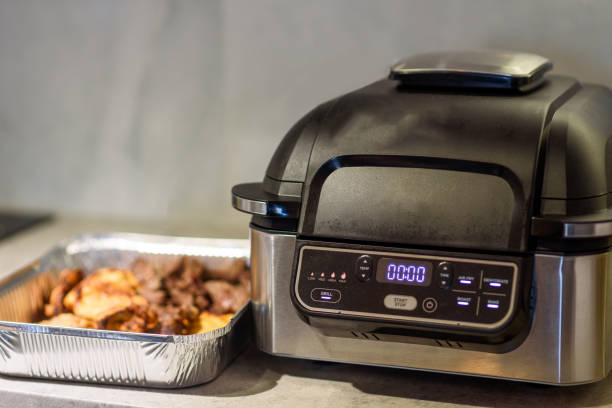
Loc Tu – Trusted Manufacturer of Durable Aluminum Foil Containers and High-Quality, Food-Safe Aluminum Foil Rolls for Your Kitchen
Your Trusted Partner in Food Packaging 📞
Loc Tu Manufacturing & Trading Co., Ltd. is more than just a supplier; we are your strategic partner in delivering high-caliber aluminum food packaging solutions. Specializing in a comprehensive range of aluminum trays, versatile foil rolls, and convenient disposable food containers.
We serve a diverse clientele – from individual households and local food vendors to large-scale restaurants, catering companies, and prestigious hotel chains. Our unwavering dedication to safety, sustainability, innovation, and customer satisfaction makes us the trusted choice for businesses and consumers seeking reliable, high-performance packaging.
📌 LOC TU MANUFACTURING & TRADING CO., LTD
📌 Our Vietnamese Website: Khaynhomthucpham.com
📌 HOTLINE/ZALO: 0969.787.309
📌 Facebook: Aluminum Foil Loc Tu
📌 Youtube: Aluminum Foil Loc Tu
📌 Tik Tok: Aluminum Foil Loc Tu
📌 Instagram: Aluminum Foil Loc Tu
📌 Shopee: Aluminum Foil Loc Tu
📌 Twitter/X: Aluminum Foil Loc Tu
📌 LinkedIn: Aluminum Foil Loc Tu
📌 Pinterest: Aluminum Foil Loc Tu
📌 Tumblr: Aluminum Foil Loc Tu
📌 Threads: Aluminum Foil Loc Tu
📌 Telegram: Aluminum Foil Loc Tu
📌 Whatsapp: 0969.787.309
📌 Branch 1 (Hanoi): No. 1 Pham Tu, Beasky Building, Dai Kim Ward, Hoang Mai District, Hanoi
📌 Branch 2 (Binh Duong): No. 68, DX 051 Street, Group 17, Quarter 4, Phu My Ward, Thu Dau Mot City, Binh Duong Province
📞 Contact us today for expert consultation and the best pricing on premium aluminum trays and foil packaging solutions! 🚀

