PREMIERE WHOLESALE ALUMINUM FOIL CONTAINERS: REVOLUTIONIZING THE CANNED MEAT SECTOR
(Introduction Title) The Evolution of Preservation: Beyond the Steel Can
For decades, the "canned meat" sector—encompassing luncheon meats, pâtés, corned beef, and ready-to-eat stews—has been visually and operationally dominated by heavy, three-piece steel cans or glass jars. However, the modern food manufacturing landscape is undergoing a seismic shift. The pressure for reduced logistics costs, enhanced sustainability profiles, and consumer demand for convenience is driving a mass migration toward advanced, high-barrier wholesale aluminum foil containers.
This is not merely an aesthetic upgrade; it is a fundamental re-engineering of the preservation process. For F&B manufacturers and large-scale processing plants, packaging is the first line of defense against pathogens and the primary driver of shelf stability. This analysis bypasses basic product descriptions to dissect the operational, financial, and technical realities of integrating aluminum solutions into processed meat production lines. We are examining packaging not as a consumable, but as a critical asset in the food safety ecosystem.
TABLE OF CONTENTS
Thermal Dynamics: The Retort Processing Imperative
Sterility Assurance: Withstanding the Autoclave Cycle
The Physics of Heat Transfer: Aluminum vs. Traditional Tinplate
Structural Integrity: Engineering for Dense Products
Smooth-Wall Technology: The Hermetic Seal Standard
Load Bearing & Rigidity: Handling High-Density Meat Blocks
The Economic Equation: Total Cost & Operational Efficiency
Supply Chain Lean Metrics: Storage & Logistics
Production Line Synergy: Filling and Sealing Optimization
Consumer Experience: The "Table-Ready" Advantage
Aesthetics & Perception: Elevating the "Spam" Archetype
Convenience Factors: Opening Mechanisms and Safety
Vendor Reliability: The Procurement Validation Protocol
Audit & Certification: The HACCP Connection
The Loc Tu Value Proposition: Customization at Scale
1. Thermal Dynamics: The Retort Processing Imperative
When dealing with low-acid foods such as meats, sterility is non-negotiable. The industry standard requires achieving "commercial sterility" through high-temperature thermal processing (retort). Sourcing the correct wholesale aluminum foil containers is vital, as utilizing standard catering trays will result in catastrophic failure under pressure.
Sterility Assurance: Withstanding the Autoclave Cycle
Name: Retort Performance Benchmark (RPB-V1)
Icon: 🌡️
Content:
Temperature Threshold: The alloy and lacquer system must withstand sustained exposure to 121°C (250°F) or higher, the standard temperature to eliminate Clostridium botulinum spores.
Pressure Counter-Pressure: During the cooling phase of a retort cycle, packaging undergoes significant stress. High-grade aluminum alloys (typically 8011 or 3003 series) in specific tempers (H22 or H24) are required to maintain structural shape without imploding or "paneling."
Lacquer Adhesion: The internal PP (Polypropylene) heat-seal lacquer must not delaminate or blister under steam saturation conditions, ensuring no metal migration into the acidic or fatty meat environment.
For a meat processor, procurement is an exercise in safety validation. Buying generic "foil pans" is a liability. You are purchasing an engineering capability: the ability to survive the autoclave without compromising the seal.
The Physics of Heat Transfer: Aluminum vs. Traditional Tinplate
The Physics of Penetration:
A crucial factor in meat processing is the "cold spot" calculation—the point inside the meat block that takes the longest to reach the target kill temperature.
The Steel Disadvantage: Traditional steel cans have thicker walls and a cylindrical shape which, while sturdy, creates a longer thermal path.
The Aluminum Advantage: Aluminum possesses superior thermal conductivity compared to steel. Furthermore, wholesale aluminum foil containers for meat are often designed in flatter, rectangular "brick" shapes. This geometry increases the surface-area-to-volume ratio.
Result: Faster heat penetration. This allows processors to reduce the dwell time in the retort cooker. Shorter cooking times equate to lower energy consumption (Scope 2 emissions reduction) and better retention of meat texture and nutrient profile.
[IMAGE 1 DESCRIPTION]
Image Content: A sleek, industrial diagram overlaying a steel cylindrical can vs. a rectangular smooth-wall aluminum tray. Heat maps (thermal gradients) show the aluminum tray reaching the center temperature significantly faster than the steel can.
Caption: Thermal Conductivity Efficiency: Rectangular aluminum profiles reduce energy expenditure during sterilization.
ALT Text: Comparison of heat transfer rates between steel cans and wholesale aluminum foil containers for meat processing.
2. Structural Integrity: Engineering for Dense Products
Meat is dense, heavy, and often contains fats and oils that can attack packaging materials. The structural engineering of wholesale aluminum foil containers must address the unique challenges of containment, sealing, and transport load.
Smooth-Wall Technology: The Hermetic Seal Standard
Wrinkle-Wall (Old Gen): Standard takeaway containers have "wrinkled" rims. While cheap, these folds create microscopic channels (capillaries) where bacteria can ingress, making them unsuitable for shelf-stable canned meats which require a vacuum or modified atmosphere packaging (MAP).
Smooth-Wall (Next Gen): The specialized category of retortable aluminum trays utilizes "smooth-wall" technology. Through high-pressure stamping, the rim is flattened to a microscopic tolerance.
The Implication: This perfectly flat surface allows for a heat-sealed film (retort lidding film) to bond chemically with the tray's flange. This fusion creates a hermetic seal capable of holding a vacuum, essential for maintaining an anaerobic environment to prevent spoilage over a 2-3 year shelf life. Procurement managers must specify "Smooth-Wall Only" for any long-life meat application.
Load Bearing & Rigidity: Handling High-Density Meat Blocks
Canned meat differs from liquids or powders; it is a solid block. During transit, the inertia of the meat inside the package can cause deformation if the walls are too thin.
The Technical Specification:
Micron Gauge: For a 200g meat pâté tray, standard 60-micron foil is insufficient. Heavy-duty applications require 90 to 130 microns depending on depth.
Ribbing Architecture: The side walls must feature engineered embossing or ribbing patterns. These act as structural beams, preventing the tray from bulging outward or collapsing inward when stacked.
Vetting Protocol: Squeeze the long sides of a sample container. There should be zero flex. Fill with wet sand (simulating meat density) and perform a vibration test. The container must retain its original dimensions to ensure it still fits in secondary packaging (sleeves or boxes).
3. The Economic Equation: Total Cost & Operational Efficiency
Procurement decisions are ultimately governed by ROI. Moving to wholesale aluminum foil containers creates distinct financial advantages across the P&L statement, specifically in logistics and warehousing ("The Invisible Costs").
Supply Chain Lean Metrics: Storage & Logistics
The Nesting Factor: Traditional 3-piece steel cans are cylindrical and cannot nest. If you buy 10,000 empty steel cans, you are shipping primarily air. A truck is "full" by volume long before it is full by weight.
The Aluminum Solution: Aluminum trays are tapered. They nest tightly inside one another. One pallet of nested aluminum trays can hold the equivalent unit count of 10 to 15 pallets of rigid steel cans.
ROI Impact:
Warehousing: Reduction of raw material storage space by up to 90%.
Inbound Freight: Drastic reduction in transportation costs per unit.
Weight: Aluminum is lighter than steel, further reducing outbound logistics costs for the finished product.
Production Line Synergy: Filling and Sealing Optimization
Central Node: Production Throughput
Branch 1: Magnetic Handling? No.
Adjustment: Unlike steel, aluminum is non-magnetic. Lines must use vacuum lifters or mechanical grippers/denesters.
Branch 2: Sealing Speed.
Advantage: Heat sealing a film lid is faster and requires less complex machinery maintenance than the "double-seaming" required for metal lids on steel cans. Double seamers need constant calibration; heat sealers are more robust.
Branch 3: Noise Reduction.
Worker Safety: Aluminum lines run significantly quieter than clashing steel cans, improving the factory environment and reducing hearing protection requirements.

[IMAGE 3 DESCRIPTION]
Image Content: A bar chart comparing "Inbound Logistics Costs." The bar for "Rigid Steel Cans" is very high. The bar for "Nested Aluminum Trays" is less than 20% of the steel bar. Icons of trucks illustrate the volume difference (1 truck vs. 5 trucks).
Caption: The Logistics Multiplier: The nesting capability of aluminum trays drastically lowers storage and shipping overhead.
ALT Text: Chart showing logistics cost savings when using wholesale aluminum foil containers vs steel cans.
4. Consumer Experience: The "Table-Ready" Advantage
The final battlefield is the retail shelf. Wholesale aluminum foil containers allow manufacturers to shed the "apocalypse ration" stigma associated with traditional canned meat and present a product that feels culinary and premium.
Aesthetics & Perception: Elevating the "Spam" Archetype
Market data suggests modern consumers recoil from the industrial look of tin cans. Aluminum trays offer a canvas for premiumization.
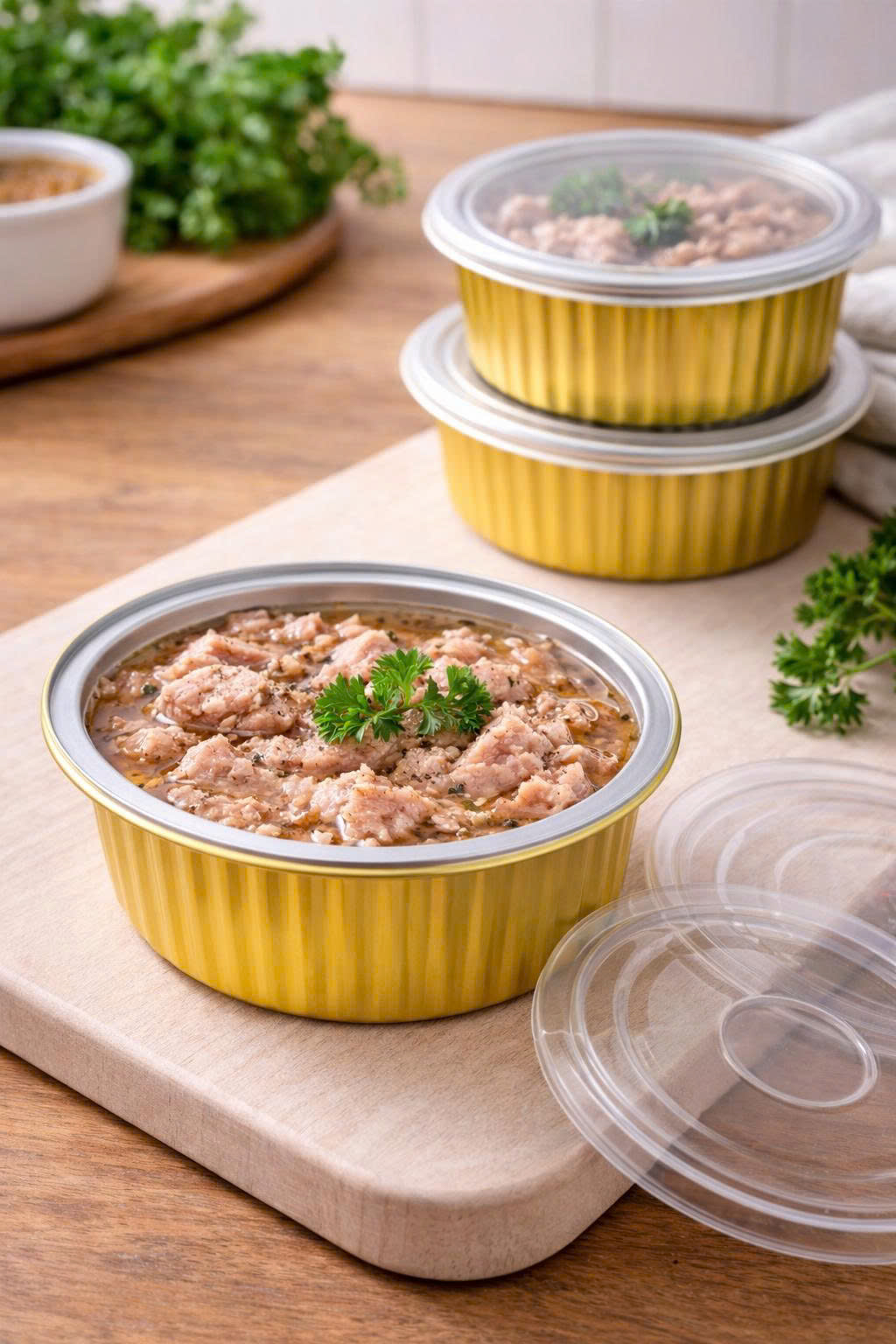
The Gold Lacquer Standard: Utilizing gold or colored lacquers on the exterior of the aluminum tray signals quality.
Direct-to-Table: Unlike a sharp, dangerous tin can, a smooth-wall aluminum tray is essentially a serving dish. For pâtés or terrines, the consumer can remove the film lid and place the tray directly on a charcuterie board. It transforms "processed meat" into "ready-to-eat gourmet."
Shape Innovation: Brands are not limited to cylinders. Rectangles, ovals, and multi-compartment designs are possible with aluminum tooling, allowing for differentiation on crowded shelves.
Convenience Factors: Opening Mechanisms and Safety
Consumer Complaint: "I hate opening corned beef cans with that little metal key. It always breaks, or I cut my finger."
The Innovation: The peelable retort lid.
By combining a high-stiffness aluminum tray with a high-performance "Easy-Peel" barrier film, the need for can openers or dangerous keys is eliminated. This "soft-open" feature is a massive selling point for seniors and children. It aligns with the "Convenience Generation" demand. Procurement teams should prioritize suppliers who can offer tray-and-lid combinations tested for "peel force" consistency (easy enough to open by hand, strong enough to survive shipping).
5. Vendor Reliability: The Procurement Validation Protocol
Finding a vendor for picnic plates is easy. Finding a partner for Class-A retort packaging requires forensic auditing. The consequences of container failure in the meat industry (botulism) are severe, making the vetting process paramount.
Audit Protocols for Meat Packaging Suppliers
The Scenario: A meat producer sourced cheap aluminum trays from an unverified online exchange.
The Incident: During the quarterly FDA audit, the inspector requested the "Migration Testing Report" for heavy metals in high-temperature, high-acid environments. The supplier could not provide it.
The Consequence: Production was halted.
The Lesson: A professional supplier must provide a comprehensive technical dossier:
US FDA 21 CFR 175.300 Compliance (Resinous and polymeric coatings).
ISO 9001 & BRC (British Retail Consortium) Global Standards for Packaging Materials.
Traceability: The ability to track a specific batch of trays back to the original aluminum ingot melt.
The Loc Tu Supply Ecosystem: Customization at Scale
Loc Tu redefines the role of a supplier from "vendor" to "technical partner."
Phase 1: Product Matching: We do not guess. We analyze your meat product's acidity, salt content, and retort cycle time to select the exact alloy and lacquer combination (e.g., PP-Laminated vs. Epoxy-phenolic).
Phase 2: Prototyping: We provide 3D samples and tooling capability for custom shapes that fit your brand identity.
Phase 3: Stress Testing: We facilitate sample runs for your autoclave validation processes.
Phase 4: Just-In-Time (JIT) Supply: Understanding the massive volume differences of nested trays, we structure delivery schedules to optimize your warehouse cash flow.

[IMAGE 5 DESCRIPTION]
Image Content: A brightly lit QC laboratory. A technician in a lab coat is inspecting a batch of golden aluminum trays under a magnifying lens, holding a clipboard with a checklist. In the background, stacks of boxed trays are ready for shipment.
Caption: Rigorous Quality Assurance: Every batch is inspected to ensure retort safety standards are met before leaving the facility.
ALT Text: Quality control inspection at a wholesale aluminum foil container manufacturing facility like Loc Tu.
(Conclusion) Precision Packaging: A Strategic Investment in Brand Safety
The transition from steel to aluminum in the canned meat sector is not a trend; it is the trajectory of modernization. Sourcing wholesale aluminum foil containers offers a triad of benefits: thermodynamic efficiency in processing, logistical dominance through nesting, and elevated consumer appeal.
However, the technical stakes are high. In an industry where seal integrity stands between a safe meal and a public health crisis, the quality of the container is as important as the quality of the meat. Procurement is no longer just about price negotiation; it is about engineering validation. Partnering with a dedicated specialist like Loc Tu ensures that your packaging is not a liability, but your strongest asset in the market. 🏗️🛡️
Loc Tu: Pioneering Excellence in Premium Aluminum Packaging Solutions
At the forefront of the food packaging industry, Loc Tu Manufacturing & Trading Co., Ltd. stands as a premier manufacturer and supplier of high-quality aluminum trays and foil rolls. We are dedicated to providing innovative, safe, and reliable packaging solutions tailored to the dynamic needs of the modern food landscape. Our foundation is b0uilt upon state-of-the-art manufacturing facilities, equipped with advanced production lines engineered for precision and efficiency. This technological edge allows Loc Tu to consistently deliver aluminum trays and foil rolls that not only meet but exceed rigorous international food safety standards.
Why You Must Choose Loc Tu?
✅ Assured Quality & Safety: Crafted from premium, food-grade aluminum, free from harmful impurities, meeting international safety benchmarks.
🔥 Optimal Thermal Properties: Ensures even cooking and excellent heat retention, preserving food temperature and taste effectively.
💪 Durable & Convenient Design: Engineered to resist leaks and dents, providing reliable performance for baking, storage, and transport.
🔄 Versatile Solutions: Our extensive range caters to various applications – from baking and steaming to storing fresh food and takeaway meals.
🌱 Eco-Conscious Packaging: Made from 100% recyclable aluminum, supporting sustainability and reducing plastic waste.
🎯 Brand Enhancement: Optional custom printing available to personalize products and boost your brand visibility.
🚚 Reliable Supply & Delivery: Capable of handling large orders with dependable, on-schedule nationwide shipping.

Loc Tu – Trusted Manufacturer of Durable Aluminum Foil Containers and High-Quality, Food-Safe Aluminum Foil Rolls for Your Kitchen
Your Trusted Partner in Food Packaging 📞
Loc Tu Manufacturing & Trading Co., Ltd. is more than just a supplier; we are your strategic partner in delivering high-caliber aluminum food packaging solutions. Specializing in a comprehensive range of aluminum trays, versatile foil rolls, and convenient disposable food containers.
We serve a diverse clientele – from individual households and local food vendors to large-scale restaurants, catering companies, and prestigious hotel chains. Our unwavering dedication to safety, sustainability, innovation, and customer satisfaction makes us the trusted choice for businesses and consumers seeking reliable, high-performance packaging.
📌 LOC TU MANUFACTURING & TRADING CO., LTD
📌 Our Vietnamese Website: Khaynhomthucpham.com
📌 HOTLINE/ZALO: 0969.787.309
📌 Facebook: Aluminum Foil Loc Tu
📌 Youtube: Aluminum Foil Loc Tu
📌 Tik Tok: Aluminum Foil Loc Tu
📌 Instagram: Aluminum Foil Loc Tu
📌 Shopee: Aluminum Foil Loc Tu
📌 Twitter/X: Aluminum Foil Loc Tu
📌 LinkedIn: Aluminum Foil Loc Tu
📌 Pinterest: Aluminum Foil Loc Tu
📌 Tumblr: Aluminum Foil Loc Tu
📌 Threads: Aluminum Foil Loc Tu
📌 Telegram: Aluminum Foil Loc Tu
📌 Whatsapp: 0969.787.309
📌 Branch 1 (Hanoi): No. 1 Pham Tu, Beasky Building, Dai Kim Ward, Hoang Mai District, Hanoi
📌 Branch 2 (Binh Duong): No. 68, DX 051 Street, Group 17, Quarter 4, Phu My Ward, Thu Dau Mot City, Binh Duong Province
📞 Contact us today for expert consultation and the best pricing on premium aluminum trays and foil packaging solutions! 🚀

